
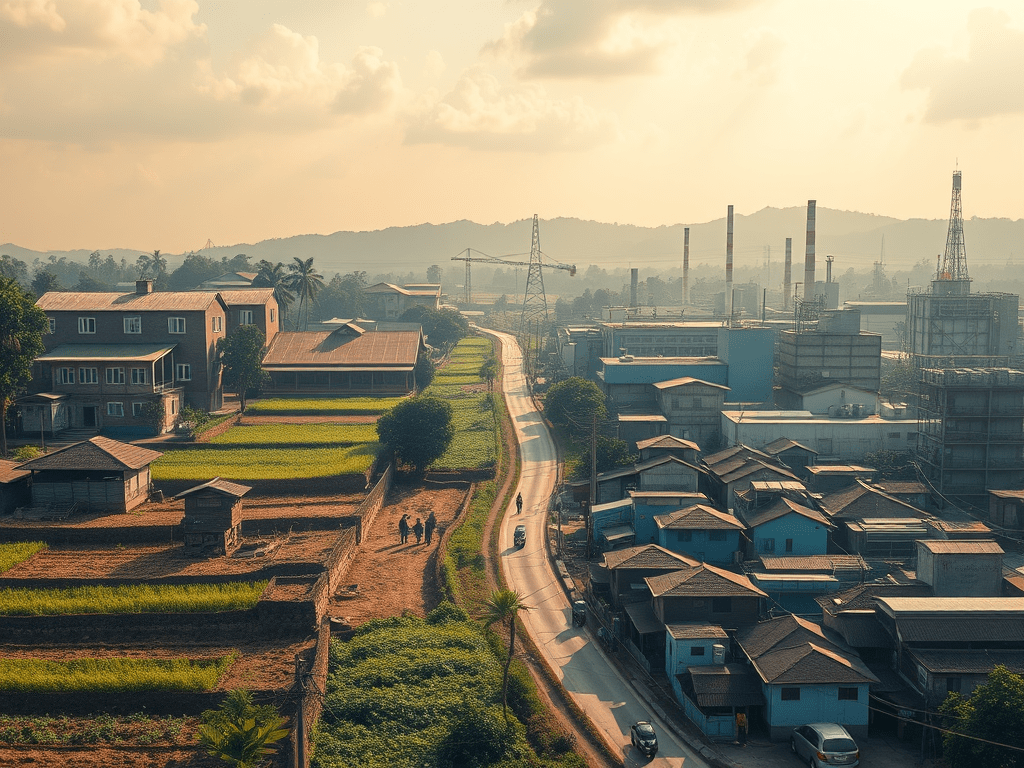
Village development in Indonesia is still not directed to support industrialisation and urbanisation. The main narrative is that there is village economic development. Suppose the direction of village funds only refers to the development of village potential, at a certain point. In that case, it is very likely to result in a decrease in benefits due to the maximised use of village resources.
In the realm of theory and practice, the ultimate goal of village development is to facilitate the economic transformation from an agrarian society to a modern economic society that relies on industrial, financial, and/or service sectors. The reason is apparent: the industrial and service industries provide higher added value than the agricultural sector. The great added value in the industrial and service industries can ultimately help the country in realising shared prosperity.
Development stages
Rostow said that economic transformation can be the path to prosperity. Five stages can be passed, namely traditional society, prerequisites for takeoff, takeoff, towards a mature society and finally a society characterised by high consumption.
The dominance of agricultural activities is the main characteristic of an agrarian society. Along with the adoption of technology, economic diversification, and investment in infrastructure, society begins to move towards the prerequisite stage for takeoff, where the foundations for economic transformation begin to take shape.
The next stage is takeoff. The primary feature of this stage is the presence of the industrial sector, which is a key source of economic growth. The development of the industrial sector can provide added value, ultimately accelerating economic diversification into other competitive industries, such as the service sector.
At the take-off stage, there are at least three main sectors in the economy: agriculture, industry, and services. One important consideration is that the agricultural sector at this stage cannot be left unattended, but must be linked to the industrial sector to strengthen the foundation of the national economy. The connectivity of the agricultural sector with industry, for example, is the adoption of machines produced by industrial production to realise an efficient agricultural sector. Ultimately, the agricultural sector can still thrive, providing essential needs for individuals who are transitioning to the non-agricultural sector.
In addition to continuing to supply basic needs in the form of food, increasing agricultural productivity at this stage enables an economic surplus that can be invested in more productive sectors outside the agricultural sector. World economic history records that the Industrial Revolution in the 1770s is an example of the take-off conditions of an economy.
Practice
In the Indonesian context, the conditions before the 1997/1998 monetary crisis were characterised by a period of national economic take-off. There is connectivity between the agricultural sector and the non-agricultural sectors. Surpluses in the agricultural sector are invested in other sectors. At the micro level, not a few farmers who owned large amounts of land at that time sent their children to college in the hope that they could work outside the agricultural sector.
Until now, Indonesia has not been said to have reached a maturity period or a stage of high consumption in society. Examples of countries at this level include G7 countries such as Japan, the United Kingdom, and the United States. Based on the existing conditions, Indonesia can be said to be still in a take-off position. This condition, if not addressed appropriately, will cause Indonesia to revert to its previous level.
Early deindustrialisation is a condition where Indonesia can fail to pass the take-off period. One of its main characteristics is that the industrial sector is no longer competitive, and its share of the national economy is decreasing. Ultimately, the pitfalls of the middle class are inevitable. Once trapped in this trap, it will be challenging to break free from the snares that have held India, South Africa, Argentina and Brazil hostage.
The opposite situation occurs in Japan. The Japanese government, at the beginning of the Meiji Restoration in the 1860s, made massive investments in infrastructure, including building a railway network and encouraging the growth of the manufacturing sector. At the same time, many Japanese youths were sent to Europe and America to learn various skills to support industrialisation. The results can still be seen today, as Japan has successfully transformed its economy from an agrarian-based one to an economy with high consumption characteristics. This change still ensures that the country of Sakura does not forget the agricultural sector as one of its key economic sectors.
Indonesia has applied this concept in the New Order era through Repelita, the Five-Year Development Plan. After the reform, in the year 2000, the direction of economic development was no longer obvious. As a result, after 25 years of reform, there is no clear development direction, such as which industrial sector will be used as the leading sector. If there is a clear direction of development, then Indonesia already has a variety of industrial sectors that can be used as the primary sector.
An example of this industrial sector diversification is South Korea. They excel in the electronics industry, with sub-sectors including the mobile phone industry, home appliances, and gadgets. Outside of the electronics industry, South Korea also excels in the shipping industry.
Repositioning of Village Development
Recognising the reality of economic transformation in developed countries, village development in Indonesia must address the challenge of achieving an industrial state while maintaining the balance of the village population. This balance is essential so that the problem of ageing in the economy (ageing population) does not occur. A decade of village funds has led to numerous improvements in village infrastructure. This is essential capital to connect villages with the industrial and service sectors. Based on data from the Ministry of Finance up to 2023, village funds have contributed to the development of basic public facilities and infrastructure in villages.
These facilities and infrastructure are the construction of health and education facilities including 9,352 posyandu, 10.12 million units of clean water facilities, 77,168 units of toilets, 79,928 units of polindes (village polyclinics), 10,495 units of early childhood education (PAUD), 29.55 million units of drainage, and up to 32.01 million units of drilled wells. In terms of economic infrastructure, village funds have produced 33,657 km of village roads, 129,979 meters of bridges, 515 units of village markets, 450 units of Village-Owned Enterprises (BUMDes) activities, 318 units of reservoirs, and 31,142 irrigation units.
The infrastructure built can enhance the village’s carrying capacity for the development of the secondary and broadcast sectors. For example, health facilities and early childhood education can be an instrument to produce human resources that can develop the secondary and tertiary sectors.
The smooth village road will facilitate the mobility of villagers to the city to seek livelihood in the non-agricultural sector. At the same time, the existence of irrigation, ponds, and reservoirs can serve as a foundation for the realisation of the sustainability of the agricultural industry, providing basic needs in the form of food. To prevent an ageing population, the government must ensure that villages can still be a place where the fate of the younger generation is at stake, as they want to rely on the agricultural sector for their livelihood.
The village is ready. Now it remains to be seen how the government ensures that the supply of resources, both human and non-human, can be absorbed in the secondary (industrial) and tertiary (services) sectors in urban areas. Improving the education system and investment in the health sector to attract a competitive workforce is an absolute requirement before inviting investors, both domestic and foreign, to invest in Indonesia.
This article was initially published in KONTAN, 10 July 2025, in Bahasa Indonesia. This article is an original manuscript that has been translated into English.

 Rusli Abdullah's Blog
Leave a comment