
The article was originally published in the Bahasa Indonesia version at Bisnis Indonesia. July 1, 2025
Rusli Abdullah
Village cooperatives amidst existing Village-Owned Enterprises (BUMDES) should not create conflict if appropriate mitigation is obtained from the central government and village governments. On the contrary, proper management between the two entities can maximise village economic management. The path to conflict mitigation is clear, given that these two business entities operate on different business models.
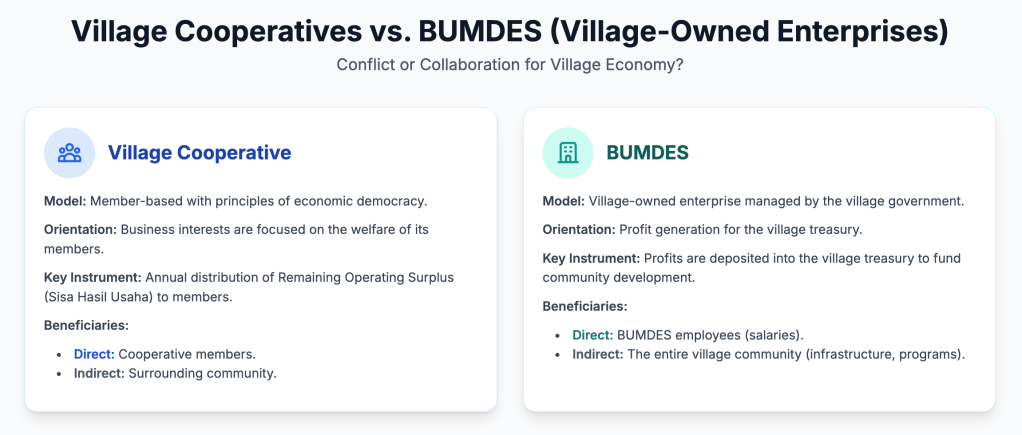
Cooperatives, which should ideally be modelled after the Merah Putih Village Cooperative, have a different foundational basis than BUMDES. Cooperatives adhere to principles of economic democracy, orienting their business interests towards their members. The definitive instrument for this is the annual distribution of the remaining operating surplus (sisa hasil usaha) to their members.

On the other hand, BUMDES are village-owned enterprises managed by the village government. Fundamentally, BUMDES is a business that must generate profits to be deposited into the village treasury. Ultimately, the village treasury will be managed for the benefit of the entire village community.
This difference in business models highlights a significant distinction in who benefits from each. For cooperatives, the direct beneficiaries are cooperative members, and the indirect beneficiaries are the surrounding community. For instance, a farmer’s cooperative that accommodates farmers in their agricultural endeavours, such as providing farming tools and machinery, can sell rice to villagers and residents of surrounding villages whose profession is not farming.
The direct beneficiaries of BUMDES can be categorised into two groups: BUMDES employees and the entire village community. BUMDES employees receive salaries for their work in developing BUMDES. The village community benefits from BUMDES through the profits deposited into the village treasury, which are then used for village development needs, such as maintaining village roads.
A successful example of BUMDES’s benefits is BUMDES Tirta Mandiri in Ponggok Village, Klaten, Central Java. This BUMDES generated a turnover of IDR 14 billion annually (2024). BUMDES employees and the local community directly benefited. BUMDES managers received salaries, and the surrounding community experienced improved village infrastructure. Furthermore, the “one house, one scholar” program in Ponggok Village is tangible proof of BUMDES’s usefulness.
Conflict
In reality, the “conflict” between cooperatives and BUMDES is not a recent phenomenon. Conflict has been present for a decade, since the enactment of Law No. 6 of 2014 concerning Villages. Before BUMDES were established, as mandated by the Village Law, many village cooperatives already existed with various statuses, ranging from dormant, barely surviving, to successful.
The conflict was not as prominent then. In the author’s opinion, village resources or potential are the reason. Cooperatives, with their membership-focused business model, were not at liberty to develop village potential, especially if cooperative officials did not support the incumbent village head in the village head election.
Another potential cause of conflict is the issuance of Presidential Instruction No. 9 of 2025 concerning the Acceleration of the Formation of Merah Putih Village/Urban Village Cooperatives. The author identifies at least two potential sources of conflict: points regarding the purpose of forming Merah Putih Village Cooperatives and points concerning the funding sources for their establishment.
The formation of Village Cooperatives has a broad scope of business activities. The implementation of cooperative activities includes, but is not limited to, cooperative offices, provision of necessities (sembako), savings and loans, clinics, pharmacies, cold storage/warehousing, and logistics. Although there is a phrase that mentions the consideration of characteristics, potential, and existing economic institutions in the village/urban village, it does not guarantee the absence of conflict between BUMDES and Village Cooperatives.
Another potential conflict arises from funding sources. Point eight of the instruction states that funding for the acceleration of Village Cooperative formation is partly charged to the Village Revenue and Expenditure Budget (APBDesa). If the mechanism is not detailed and precise, this can create conflict between BUMDES management and Village Cooperative management.
Conflict Mitigation
Conflict can be mitigated because Cooperatives and BUMDES have vastly different business models. Cooperatives are member-based, while BUMDES are business-as-usual. Several ways to reduce conflict include carefully mapping village potential, clear regulations, especially at the grassroots level, and a deep understanding of the core business differences between cooperatives and BUMDES for both BUMDES and cooperative officials.
Mapping village potential is essential to optimise resource allocation between cooperatives and BUMDES. For example, if a village has a market owned by the village and managed by BUMDES, the village cooperative, whose members are farmers, can sell their commodities in that village market. Another example is the formation of a village cooperative focused on on-farm activities, while BUMDES focuses on off-farm activities. For instance, a farmers’ cooperative focuses on cultivation up to harvest, while BUMDES operates in post-harvest or vice versa.
The second necessary step is clear rules of engagement for utilising the existing village potential. Village regulations will effectively mitigate conflict because they better capture each village’s unique characteristics. Higher-level regulations should only serve as guidance.
The third mitigation strategy is to foster a comprehensive understanding of the concepts of BUMDES and Village Cooperatives among village governments, village officials, BUMDES management, and village cooperative management. The simplest understanding to convey to them is the difference in the core business of these two economic entities.
These mitigation pointers will successfully minimise conflict if the formation of Merah Putih Village Cooperatives continues to adhere to the spirit of the Cooperative Law and the fundamental philosophy of cooperatives themselves, namely, economic democracy.

 Rusli Abdullah's Blog
Leave a comment